

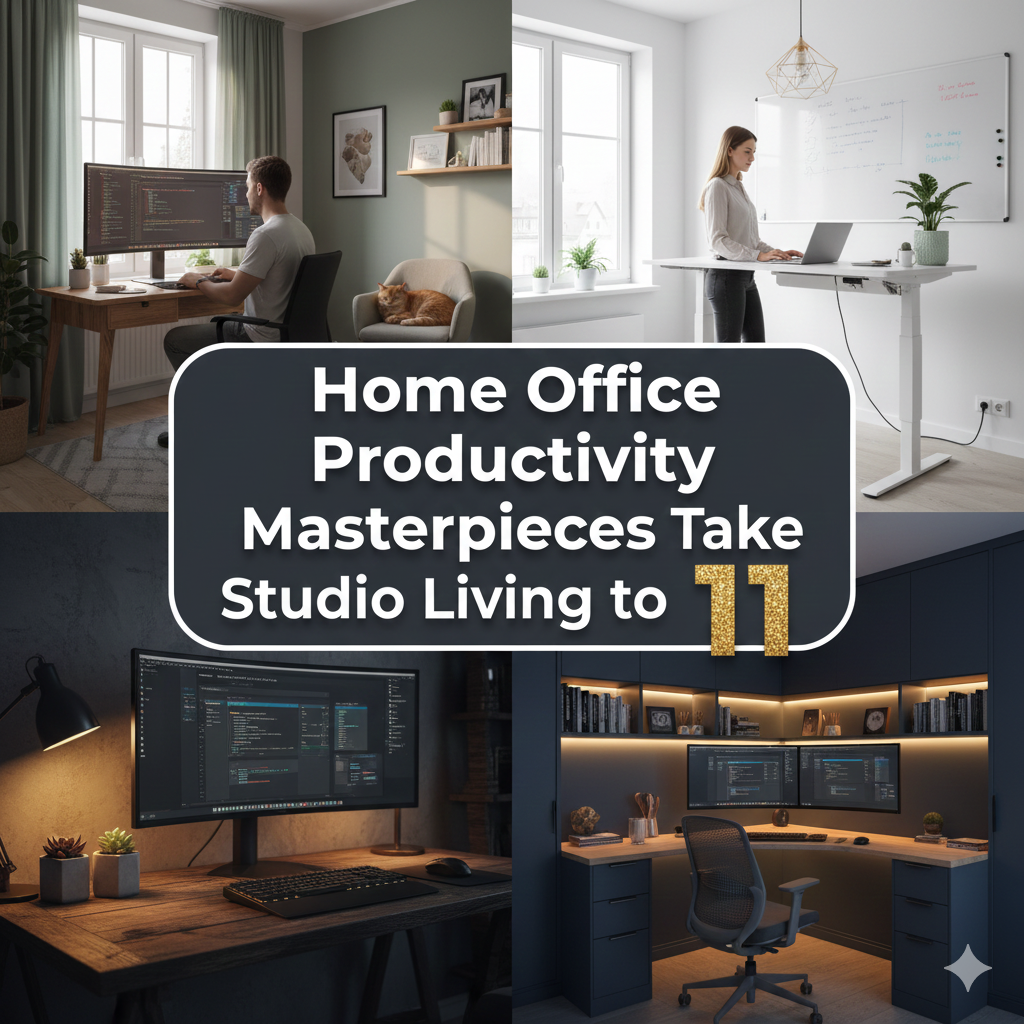
Why Your Studio Apartment Needs a Real Home Office
It is hard to work from a studio apartment. You eat, sleep, chill and work — in the same room. It can be cramped, chaotic and draining.
But the good news is this: your studio — with the proper home office productivity setup — can be one of the most efficient workspaces you’ve ever had.
There’s no need for a separate room. You don’t need a giant desk. You just need a smart plan.
Here are 6 of the best home office productivity setups made specifically for those working in studios. They’re each practical, budget-friendly and made for helping you concentrate — no matter how small your space is.
What Makes a Home Office Work in a Studio?
Before diving into the setups, let me provide some foundation. The three essential elements of a productive studio home office are:
- Clear boundaries — your mind needs the clear signal that it’s “work mode”
- Storage — because clutter is focus’s enemy
- Proper lighting and ergonomics — your body will thank you, and your eyes
| Key Factor | Why It Matters |
|---|---|
| Dedicated work zone | Limits mental fatigue and distractions |
| Vertical storage | Saves floor space in cramped quarters |
| Natural + task lighting | Minimizes eye strain, mood lifter |
| Ergonomic chair/desk | Preventatives for back and neck aches |
| Cable management | Keeps the area calm and clean |
And now, back to the actual setups.
Setup 1: The Fold-Away Desk System
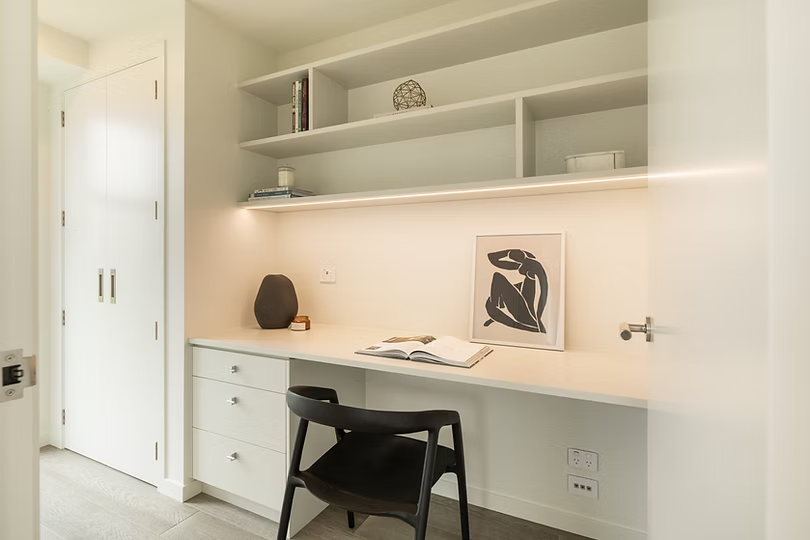
Perfect For: Renters and Minimalists
If your studio measures under 400 square feet, every inch counts. The fold-away desk system is one of the most popular home office productivity setups because it vanishes when you’re done working.
A wall-mounted fold-down desk (also known as a Murphy desk) lies flat against the wall when not in use. When it’s time to go to work, it swings out and you have yourself a full workspace. Some are even equipped with built-in shelves and cable organizers.
What You’ll Need
- Wall-mounted fold-down desk (at IKEA, Wayfair or Amazon)
- A comfortable chair that folds away or can double as living room seating
- A monitor arm to free up desk surface area
- A pegboard to hang tools and supplies above the desk
Why It Works
When your desk disappears, your brain stops associating that wall with “work.” This is a huge deal for mental health in studio living. You can actually be present in your space, instead of just staring at a pile of things you never finished.
Pro Tip: Use a different color on the wall behind your fold-away desk. Even a single accent wall establishes a visual “work zone” without utilizing any floor space.
Setup 2: The Command Center at the Corner
Best For: Heavy Computer Users and Freelancers
One of the most wasted spaces in a studio apartment, corners go underused. The corner command center configuration transforms that dead zone into a full productivity hub.
An L-shaped or corner desk fits snugly into any corner for two full work surfaces. You can arrange a monitor on one side and paperwork (or creative tools) on the other.
Building Your Corner Command Center
Here’s a basic structure you can follow:
| Zone | What Goes Here |
|---|---|
| Left surface | Main monitor, keyboard and mouse |
| Right surface | Notebook, planner and second screen or tablet |
| Above the desk | Floating shelves for books and supplies |
| Under the desk | Rolling drawers or a small filing cabinet |
Lighting Setup for This Configuration
Lighting is what can make or break this setup. Use a combination of:
- Overhead lighting — a ceiling light or track lighting directed toward the corner
- Monitor bias lighting — an LED strip mounted behind your screen to limit eye strain
- Desk lamp — adjustable arm, great for task lighting on the right side
If they are not well lit, corner setups can feel dark. Just bias lighting can make a world of difference and costs less than $20.
Setup 3: The Floating Shelf Workstation
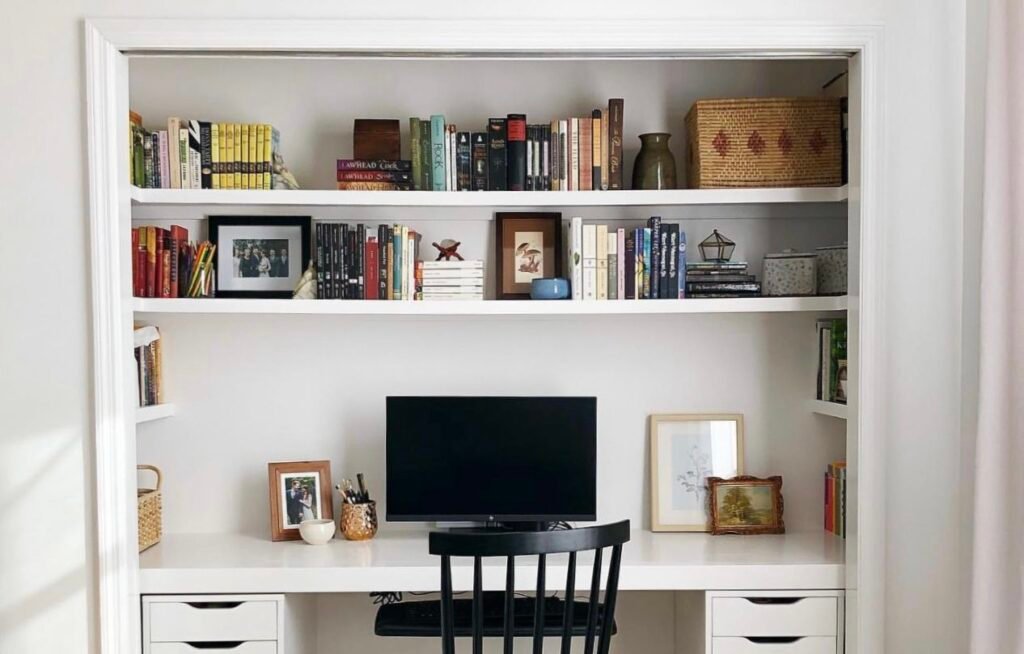
Ideal For: Creative Professionals and Students
No room for a desk at all? No problem. The floating shelf workstation is one of the most space-efficient home office productivity setups in existence.
The concept is straightforward: attach two to three deep floating shelves to a wall, at standing or seated desk height. Toss in a monitor, keyboard and some accessories — now you’ve got a complete workstation with zero floor footprint.
How to Set It Up
- Use 10–12 inch deep shelves rated for at least 50 lbs
- If it’s a seated setup, mount the main shelf at 28–30 inches high (or 44–48 inches for standing)
- A second shelf above holds your monitor at eye level
- Use a higher-up third shelf for storage, books or plants
Making It Comfortable
Seating is a major challenge with this arrangement. Without a traditional desk, you need a stool or chair that fits snugly under the shelf.
A backless counter stool works well. When not in use, it slides fully underneath the shelf, helping your studio appear neat.
Setup 4: The Multitasking Furniture Setup
Just Right For: Studio Dwellers Seeking Style and Function
This is about being savvy with every piece of furniture you acquire. Every piece of furniture in your studio is thus required to serve at least two purposes.
Examples:
- A table that serves as both a desk and a dining table
- A storage ottoman that keeps office supplies and serves as extra seating
- A room divider that doubles as a bookshelf, separating your workspace from your sleeping space
- A sofa table behind your couch that turns into a standing desk
The Room Divider Hack
One of the smartest tricks in studio home office design is to use a bookshelf as a room divider. Put a tall, open bookshelf perpendicular to the wall between your bed and your work area.
This enforces a physical and visual separation between sleep and work — key for mental health when living in a studio.
| Furniture Piece | Primary Use | Home Office Use |
|---|---|---|
| Dining table | Eating | Working desk |
| Storage ottoman | Seating | Supply storage |
| Bookshelf divider | Storage | Zone separator |
| Sofa table | Décor | Standing desk |
| Ladder shelf | Display | Organized filing |
Don’t Forget the Aesthetics
Dual-function furniture does not need to look cheap or messy. Stick to a cohesive color scheme — whites, wood tones and charcoal are best for small spaces. This helps the studio feel cohesive even when your “office” is practically next door to your couch.
Setup 5: The Vertical Productivity Wall
Ideal For: Structured Organizers and Visual Mind-Mappers
When there is not enough floor space, you go vertical. The vertical productivity wall is among the best visually impactful home office productivity setups for studio apartments.
The idea: turn one whole wall into your productivity zone. All the things you need — monitor, keyboard tray, calendar, whiteboards, file organizers, charging stations — are mounted on that wall.
What to Hang on Your Productivity Wall
Here’s a full breakdown:
Top Section (eye level and above):
- Wall-mounted monitor arm
- Floating shelf for speakers or plants
- A mini whiteboard or corkboard for jotting down thoughts and ideas
Middle Section (arm’s reach):
- Keyboard tray (retractable)
- Pegboard with hooks for headphones, cables, pens
- Small letter trays for paperwork
Bottom Section (floor level):
- Rolling cart that fits under keyboard tray
- Wall-mounted power strip (no cable spaghetti)
- Small drawer unit for stationery
Cable Management Is Everything
The most significant visual issue in any home office — especially a studio — is cable clutter. On a vertical productivity wall, install raceways for the cables, or adhesive cable channels, to run all wires neatly down the wall and into a single power strip.
This makes the wall appear clean and purposeful, not haphazard.
Setup 6: The Zen Minimalist Desk
Perfect For: Remote Workers Seeking Deep Focus
Sometimes less is more. The zen minimalist workspace pares your home office down to the bare essentials — and nothing more.
This has particular benefits for the writer, coder and anyone who needs deep, distraction-free focus.
The Core Essentials Only
- One clean desk (nothing on the surface)
- One good monitor or laptop stand
- One quality keyboard and mouse
- One lamp
- One plant (optional but known to increase focus)
That’s it.
No paper stacks. No extra monitors (unless necessary). No coffee cups, cables or random objects sitting around. Every item on the desk has one purpose.
The Psychology Behind Minimalism
Research shows time and again that visual clutter fights for your attention. Each object in your line of sight consumes a bit of mental energy.
By keeping your workspace bare, you release that mental energy for real work. In a studio apartment — where you’re already encircled by the clutter of life itself, your bed, kitchen and entertainment area — a minimalist desk becomes a sanctuary.
How to Maintain It
The most challenging aspect of a minimalist workspace is not the setup. It’s keeping it that way.
Your daily rule: Before you leave your desk, spend 2 minutes completely clearing it. Everything gets put into a drawer, shelf or storage box. Every day, the desk resets to zero.
This single habit can change your productivity levels in a studio apartment.
Selecting the Perfect Setup for Your Studio
Not every configuration works for everyone. Here’s an easy way to determine which one suits you best:
| Your Scenario | Ideal Configuration |
|---|---|
| Compact studio | Fold-Away Desk System |
| You use dual monitors | Corner Command Center |
| No space for an office desk | Floating Shelf Workstation |
| Your hours are irregular | Dual-Purpose Furniture Setup |
| You are a visual planner | Vertical Productivity Wall |
| You require daily deep focus | Zen Minimalist Workspace |
You can even combine pieces from different setups. Mix the minimalist desk with a vertical wall behind it, for example. Or deploy fold-away furniture with a command center on one side.
For more inspiration on building the perfect remote workspace, visit Remote Work Desk Setup — a resource packed with desk ideas, gear guides and layout tips for every type of remote worker.
The 5 Non-Negotiables for Every Studio Home Office
No matter which setup you choose, these are the five essential elements every studio home office productivity setup needs:
1. Good Ergonomics
Your chair and desk should be at appropriate heights. Your screen should be at eye level. You want your feet flat on the floor. Poor posture results in chronic pain — and that derails productivity faster than any distraction.
2. A Reliable Internet Connection
Even in a studio apartment, where you place your router matters more than you think. Keep it out in the open (not inside a cabinet), and consider a Wi-Fi extender if your workspace is far away from the router.
3. Noise Control
Studios are often noisy. Invest in a good pair of noise-canceling headphones. If neighbors or street noise are an ongoing issue, add a small white noise machine.
4. A Start and End Routine
In the absence of physical distance between “home” and “office,” routines become your boundary. Begin the same way every day (brew coffee, go to the desk, put in headphones). And close it the same way too (close laptop, clear desk, physically leave the work zone).
5. Enough Lighting
Bad lighting leads to fatigue and eye strain. Use ambient, task and accent lighting in combination. Don’t work in a dark room with only a bright monitor — always light the room as well.
According to research from Harvard Health, taking short physical breaks and maintaining good posture in your workspace can significantly reduce fatigue and improve long-term focus — a great reminder that your setup is only as good as the habits you build around it.
A Quick Comparison of All 6 Setups
| Setup | Space Required | Price Range | Main Feature |
|---|---|---|---|
| Fold-Away Desk System | Very Small | $100–$400 | Disappears when not in use |
| Corner Command Center | Medium | $200–$800 | Most screen real estate |
| Floating Shelf Workstation | Very Small | $50–$200 | Zero floor footprint |
| Dual-Purpose Furniture | Small–Medium | $150–$600 | Every item is multipurpose |
| Vertical Productivity Wall | Small | $100–$500 | Visually organized + space-saving |
| Zen Minimalist Workspace | Any Size | $50–$300 | Totally reduces distraction |
FAQs: How to Set Up a Home Office for Studio Living
Q1: Can I ever really have a productive home office in a studio apartment? Absolutely. Thousands of full-time remote workers, freelancers and students live in tiny studio apartments. The key is establishing intentional zones and deploying smart furniture. It’s not a studio that limits your productivity — it’s poor planning.
Q2: What is the least expensive home office setup for a studio? The most affordable option is the floating shelf workstation. Two floating shelves and a stand for your monitor cost less than $100. Add in a folding stool and you have an actual workspace for very little money.
Q3: What’s a good way to separate work and sleep in a studio apartment? Use a physical barrier — a bookshelf, curtain or room screen — between your bed and place of work. Even a tiny visual barrier tells your brain that these are two separate zones. Also, a defined start and stop routine reinforces that separation mentally.
Q4: Are standing desks worthwhile in a small studio? Yes, if you can afford it. Having a sit-stand desk (or even a standing desk converter) allows for some flexibility during the workday. Research shows that alternating between sitting and standing combats fatigue and helps maintain focus. For a studio, look for compact electric standing desks under 48 inches wide.
Q5: How do I best set up lighting for my studio home office? A three-layer lighting strategy works best: ambient light for the room, a dedicated desk lamp for task lighting and bias lighting behind your monitor to reduce eye strain. Natural light is ideal — position your desk near a window when you can, but use blackout curtains or blinds to eliminate glare.
Q6: I work from a studio and find myself feeling distracted. What helps? Noise-canceling headphones are your best friend. Beyond that, clear desk surfaces, a dedicated work routine and visual separation from your relaxation area all contribute. Some also practice time-blocking, breaking the workday into focused chunks with breaks built in.
Q7: Do I have to have a second monitor or can I just use my laptop? You can manage with just a laptop, but having an external display — even a compact 24-inch screen — greatly increases productivity. It lessens neck strain and provides more screen real estate for multitasking. If space is an issue, use a monitor arm to keep it elevated and off your desk surface.
Final Takeaway: Make Your Studio Work For You
The reality of living and working in the same space is a daunting one. But it’s also a chance to create something that’s uniquely yours.
The best home office productivity setup for studio living isn’t the most expensive one. It’s the one that suits your habits, your work style and your space.
Start small. Select one of these setups that feels right. Try it for two weeks. Adjust as you go.
Whether you want a fold-away desk that vanishes come 5pm, or prefer to install a vertical productivity wall and keep everything in order, the idea is the same: build a setup where you can do your best work — even in the smallest of spaces.
Your studio isn’t a limitation. The right setup can make it your competitive advantage.